Marketing and the importance of planning and research

Of all the functional areas of a business, marketing can well be the most pervasive and dynamic activity. In my opinion, marketing should lead all other functions as it is in the information culled and the analysis undertaken by the marketing company (or marketing department) where the decisions and planning can be made. For example, once you know how your website performs in search and/or which pages convert the most sales, you can then make a decision on whether to capitalize on this or improve on it. Similarly, existing clients can be the best source of information so the results of analysis into why they bought from you, when and how could again be expanded on and/or improved.

However, every department of a business is dependent on the organisation having clear, unambiguous and quantifiable objectives in order for it to succeed and, with more and more emphasis being placed on achieving a return on any investment made, it is the allocation of and administering of the marketing mix that will influence the long term planning.
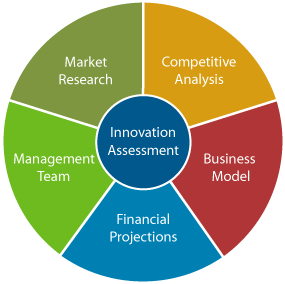
The marketing mix consists of 4 key variables – 

  1. Product
  2. Price
  3. Promotion
  4. Place

Sometimes packaging is added to the list, but this can also be included into the “promotional” part of the mix. One key aspect to consider is that the mix elements are interdependent – alter one and another will also change.

So, what will be the “the marketing policy” of your organisation? My suggestion would be to try and look at the marketing mix in relation to –

  1. Determining the kind of product to sell
  2. Defining the customers at whom the marketing effort should be directed
  3. Defining the action and procedures to be implemented to get the products/services to the customer

If you or your business needs marketing help, then please let me know.

What makes up a brand?

Bath Marketing Consultancy has been asked a number of questions recently about the word “brand.” These questions usually relate to whether a logo is a brand or whether a brand is more than that and if so, what?

Therefore, below is my take on what makes up a brand and, if you invest time, money and resources into your brand, you are very likely to reap the rewards. Branding, Brand, MarketingA brand will be made up of a collection of different perceptions that will have been built up after exposure to every aspect of your business. This can be a myriad of different things:


  1. Product design and experience
  2. Packaging
  3. Sales experience – your sales people or distributors
  4. Service experience – during the sale and after
  5. Advertising messages and straplines
  6. The way you look and sound – imagery, colour, fonts, personality and tone
  7. Your website, blogs or mentions on social networking sites
  8. The price, and how you discount
  9. Your reputation
  10. The shop, office or factory experience
  11. Uniform, badges, vans and trucks
  12. Your people
  13. The logo
  14. Your name

Bath Marketing Consultancy is an expert at developing, building and then marketing brands so please let us know if you need any help.

Managing business growth. What do you do?

I thought that this subject was one that could well strike a chord with a lot of my readers and clients as a high percentage of them have been going for 18 months or so now and are experiencing what I have been experiencing for quite some time now – success and growth.

Growth and business success creates a dilemma. Do I staff up to cope with the increasing workload, do I restructure, do I put prices up, do I cull less profitable clients or do I continue to juggle things in house?

Bath Marketing Consultancy has been going for 26 months now and we have worked with over 60 different organisations in that time. Some of these clients have become regular clients and some were one off projects. However, the growth I mentioned has indeed presented me with the dilemmas above as, after all, there are only a certain amount of hours in a day, days in a week etc to manage the requirements.
Dilemma time.

In addition, it is not just managing the actual workload. I am finding that administrative requirements have rocketed; areas like banking, invoicing, reports and simple paper work and filing are taking considerably longer. In addition my travel has increased as have my hours.

But…..I am complaining? No.

These are incredibly tough times for businesses which put even more pressure on having a successful marketing strategy. I don’t know about you, but I feel the success of Bath Marketing Consultancy is down to us being passionate about marketing, having a clear USP (pay as you go marketing), being good at what we do and, above all, being approachable, professional and friendly.

Yes, I have staffed up. Yes, I have roped in my wife to help with the admin side of things and yes, I am considering a price hike. Ride the wave while it is here I say, but ensure that you have time for yourself. All work no play can become very dull!

If you want me to take a look at your business and how you market yourself, get in touch with Bath Marketing Consultancy for a free initial chat. 

Direct mail or do you mean direct marketing?!

Direct Marketing

Let’s just clear up one thing to start with…do not get confused between direct mail and direct marketing! Direct Marketing is NOT direct mail! Direct marketing is a marketing method and direct mail is just one of the media available. It traditionally formed a large part of direct marketing, but it has now been overtaken by press and TV advertising who display a response device like a dedicated Facebook webpage.

I feel direct marketing is a key element to business growth and the main objective of the activity a business undertakes should be entice the prospect to emerge from your “warm prospect” list and respond so that you can start a conversation which will lead to a meeting which will lead to a problem-solving conversation, a first job and eventually a business relationship.

But….do not forget existing clients. If you have got something new to say, or something new to offer,  then they should be the people who hear from you first. After all, existing clients should be the fertile ground for your marketing and should be the group that are most likely to respond to a cross sell or an additional product or service!

Remember when you are trying to generate a response that there is not “ideal” per cent response rate – just the profit per reply calculation. However, if your direct marketing does elicit a  response, you must react promptly to the requests that come in.

But…..before you can even think about response and profit, prospect or existing client, you must face the biggest challenge of direct marketing – your own database/mailing list. 

If you are considering direct marketing and need some help, get in touch with Bath Marketing Consultancy.

To pitch or not to pitch

When I left the advertising “agency” world back in 2009 after long stints in Fleet Street, The Channel Islands and Bristol, one thing I promised myself was NO MORE PITCHING. By that I mean that I decided that I was never going to do any more glamour parades where I was one of 4 or 5 companies being seen and sometimes there was more than 1 round.
Why? Because of the strain on resources each pitch took and in all honesty, I sometimes found the process a bit of a lottery as, on some pitches I have done, it didn’t seem to matter how good the creative I presented was or the marketing strategy I had put together, somebody in Procurement just turned to page x on the document as, that was the costings page, and they then based their decision on this.
Do the pitch!
Two years on and no major pitches done, I have now broken my promise. Yesterday I pitched a large prospect in the leisure/holiday sector as one of 3 companies in line for their account. Was it a drain on resources? Yes. Did it mean I was stressed? Most definitely. But…..did I enjoy it? Well…. masochistically, yes. It was actually great to be in a high pressure situation again, pitting myself and my business against larger, more established organisations and knowing that I had to be at my best.
Although I don’t know the result yet, I think I put together a really good team and the result may well give Bath Marketing Consultancy real feedback as to where my company is in relation to my sector and exactly how far it has come since it opened in 2009. Would I do a pitch again? Probably, although a lot depends on the client, their location, their fit with my marketing company and the possible return on investment.
So, when it comes to doing pitches, my suggestion has now changed to “never say never.” Sometimes the adage of speculate to accumulate is very true and putting yourself and your business in the firing line vs larger competitors can act as a real evaluational tool.
If you want some tips on what to do before a pitch, see my previous post here.

Technology means you CAN take time off.

Worldwide access

I cannot tell you all how much better I have felt this week while away from my business than last time I took a week off back in October 2010. After that week, I wrote a post about the merits of working while officially off which provoked a number of comments as I found myself working every night and very stressed, but this time, things have been very different for me.
Why?
Well, for a start, the investments I have made in technology have made a huge difference. I now have a “proper” office so am able to separate work time and home time much better. Even better is that, in my office I have a VOIP phone system that takes messages and emails me the voice mail message via Quick Time so I never miss a call.

In addition to this, Bath Marketing Consultancy has grown significantly over the last 6+ months and I am now in a position to work with a creative director who can act as my back up while I am away and/or out of the office. Although not an “employee”, he is a retained freelancer with a Bath Marketing Consultancy email address and we have been working together for over a year on a project by project basis anyway so he knows my business, my brand and most of my clients.

The final ways that have helped me relax (well, I say relax, but I have 3 children under the age of 5 so I use the expression loosely!), is that the house I have rented has wi fi which allows me to access the PC in my office remotely via a system called “Team Viewer” if I need to and of course, no business would be complete these days without the obligatory iphone which syncs with my email system via an external email exchange.

I cannot tell you how much easier it is to have a few days off knowing that all phone calls are covered and that there is someone else to help if need be and the investments my business has made in technology make breaks far easier to take. I wont lie and say that this week has been client free. In fact, I have had 2 new enquiries, worked on a new logo for a client, produced 2 new A4 folders plus started putting together a new website, but I now do it with a smile on my face rather than a look of frustration and panic!

What do you think? Are you able to take time away from the “coal face” or are you a slave to your business? Let me know by leaving a comment below.

What is the best form of marketing for my business?

This question has raised its head a number of times recently as we are entering a time where seasonal fluctuations for some businesses can mean a downturn in business, but, in all honesty, it is very tricky to answer this one.

As we all know, each business is different and therefore is likely to require different results from its marketing activity. i.e yes, sales are key, but what sort of sales and would increasing repeat business be a quicker way to increase revenue rather than driving new client acquisition?

So……….how do I answer this question of the “best marketing” without possibly coming across as evasive?? Well, I tell clients and prospects that the only true way of discovering what works for their businesses is to test initiatives. For example, don’t fall victim to the Chinese whispers that direct mail doesn’t work or advertising doesn’t work, try them and see what happens. Include reference numbers and/or unique phone numbers to gauge response levels.

Also, I have found that, as marketing budgets shrink, ROI expectations seem to be increasing and some clients seem to pin all their hopes on a quick fix to a problem. 

Talk to someone!

Stop this now! Marketing is all about identifying and fulfilling a need and this takes time. Don’t think of marketing as spending unnecessary money. Think of it as investing in the future of your business and building your brand. 

The true success of a brand is measured in years and decades not months so don’t give up at the first hurdle and, if need be, talk to someone outside of your business to see what he/she thinks.

Search Engine Optimization – what not to do.

Play with a straight bat.
Following on from my previous article about what to do for SEO, please find Bath Marketing Consultancy’s list of don’ts –
1. Avoid cloaking – Cloaking is when you give your visitors one page and then give search engines another page. Google and its friends want to see and index what your visitors see. Getting caught cloaking can have dire consequences on your site ranking.
2. Avoid keyword stuffing/spamming – This is stuffing your webpage with keywords that are only intended at tricking the search engines. Google is wise to this so, to get the best outcome, just write your text, with keywords in mind, towards your audience.
3. Avoid using flash or javascript for your navigation methods – Search engines usually can’t read these, or read them well enough to be dependable. Always use standard html links to be sure your site is easily walk able by search engine spiders.
4. Don’t submit your webpage url too often, if at all – You can submit your url directly to search engines, though search engines prefer to find your website via a backlink or incoming link. Resubmitting weekly or monthly can heavily damage your ranking with the search engines.
5. Avoid the “quickly get submitted to thousands of search engines” deals – While many of these do what they say, keep in mind that 98-99% of all search engines are powered by Google, Yahoo, or MSN. Just keep these 3 in mind and you’re covered.
6. Don’t forget backlinks – Link popularity plays very large into how your site is ranking by search engines, and is always a key element of SEO. Miss the backlinks part, and your SEO will suffer quite a bit.
7. Avoid excessive graphics and flash presentations – This is not to alter how the search engine looks at your site (directly), but at how your visitors view your site. There are many ways to make an effective website without overloading your visitors, and if a website takes more than 5 seconds to load, you will likely lose your visitor before they even get to visit your website.
To me SEO is about ticking the right boxes and making things relevant and easy for Google. Yes, there are tricks of the trade, but playing with a straight bat and making your site relevant, trustworthy and, above all, trustworthy will really help in effective SEO.