Treat your company as a brand – research it and define it.

Hands up who knows what a brand is? Well, there are lots of so-called definitions, bu the CIM defines a brand as having the following criteria –

Clarity of perception
You must have to stand for something – a USP with which your company is associated and which make up your property. Your USP must underline everything you do and say. Once you’ve established this, you use it in all your communications.
A positive perception
Yes, I know this might sound obvious, but have you checked that your USP is both unique and appealing…or even accurate?! Too often I have seen that the claim doesn’t actually produce the anticipated perception among the intended prospects. Be bold, give the prospects something to hang their hats on!
A level of differentiation
Bath Marketing Consultancy is constantly asked for the work we do for our client to be “different” from what else is on the market. Differentiation can be very subjective, but the questions to ask yourself is, is my offer clearly distinctive? Really try to avoid being bland or boring or worse still, indistinguishable from the competition.
Reach (or spread)
When actively marketing your company, your aim should be to get the maximum number of prospects for the minimum expenditure. Using multiple initiatives should mean trying hard not to overlap. Instead, your marketing should aim to extend your reach using different media.

What we advocate is standing back and taking a look at yourself – you are a brand in a highly competitive market.

Do not feel ashamed to ask for help! 

Outsourcing sales and marketing….yes or no?

Outsourcing sales and marketing....yes or no?A question posed to me recently by a prospect was “is this process called “sales” something that could be outsourced as we don’t really have the time to do it properly?”

My simple answer was…”no!”

To me, is it possible for an outsider to make the impression required and not be found out as some sort of impostor! The only way in which it could work is for that third party to be incredibly economical with the truth especially if the prospect presses for answers to questions such as “who exactly are you?!”

I would never advocate putting your companies reputation on the front line without the person doing it having an intricate knowledge of your company. However, what you can outsource is the marketing of your organisation; the getting in front of people bit.

We’ve met a number of new organisations already in 2014 and have uncovered a trend in the larger ones where “marketing” is largely initiated in house. When pushed what they mean, inevitably areas like the brand, the website, the construction of the sales database and even the printed material had been done in house. So, on face value, these larger organisations seemed to be very active with their marketing, but they had turned to us for a review of their activity to see where things could be improved upon.

There is nothing wrong with having an in house team of people to administer marketing, but in our experience, the messaging and strategy must be correct before platforms like social media, direct mail, email marketing etc are configured and used and, to get these elements correct, I feel that turning to someone external and independent is the best way forward.

Be careful not to treat all prospects the same and bombard them with the same message. Similarly, why not take a step back and actually ask them if they want to hear from you and if so, using what platform. Do they want an eshot or something printed in the post? Would they prefer to hear certain things like case studies, advances in your resources or even new people? What features and benefits are you telling each category of prospect about – do you cherry pick the information you send out?

Also, what about your team? Do they all understand the core values of your business? Do they buy into them? Have you talked to your clients about what they like about you?

Do not under estimate the effectiveness of going backwards a step before going forwards with your marketing!


Your marketing in 2013, good or bad?

So, how was 2013 for your business? What marketing activity did you undertake? What worked and what didn’t? Did you try anything new?

For Bath Marketing Consultancy 2013 has been a year of sustained growth as we’ve seen demand for more strategic marketing increase. By this I mean that the clients we work have been open to the construction and implementation of more of a long term plan of attack which has strategic deliverables rather than maybe coming to us for one-off “projects” such as website design and/or updated marketing collateral.

In general I feel that marketing seems to be on more radars than in previous years and it has moved up the “to do” list for a lot of companies! We’ve also seen growth in more vocational sectors such as leisure, financial and recruitment showing that confidence is improving.

In terms of the initiatives themselves, “online” is still is at the forefront of marketing requirements certainly for the SME. In addition, more clients seem to be embracing emarketing as a marketing tool as it can offer a very cost effective route to maintaining brand awareness as well as driving traffic to dedicated areas on websites…..providing the recipient database is clean and up to date!

What do we predict will happen in 2014?
We think that demand for online solutions will increase i.e. having a website that performs well in search and actually engages customers as well as provides an online brochure. We also think that video will come into its own in 2014 as a marketing tool not only as a way of allowing prospects to “see” the companies they are considering working with, but also as a way of companies showcasing their staff, case studies and posting updates from key people within organisations.

When you sit down and plan your marketing for 2014, do remember that marketing is a process and not a singular event. In order to have an effective marketing platform you need to test new initiatives and, if possible, have 5 or 6 activities running together on a monthly basis. These can be keeping your social media platforms up to date, picking the right networking group to attend, submitting press releases to local media and of course, reviewing what you do on a regular basis.

Try not to see marketing as a cost. See it as an investment in the company and bring in someone if need be to audit everything and work with you to achieve your goals.

Focus on what marketing you use and when you use it

This might sound like an obvious things to say, but the key word here is “focus.” i.e Focus on the message of your marketing and focus on the timing of its delivery. With regards to the actual message, are you sending out the right message to the right people? Is your marketing message consistent and/or part of a larger mission statement? Either way, my suggestion is to make sure that you break your marketing plan into clearly defined segments which detail what each segment is supposed to achieve. For example, if your objective is to convey the message that your company makes the best xxxx’s on the market, are you talking nationally or locally? What platforms are you using to convey this message? How often and what style are you using? Consider all these anomalies before going “live” with anything!

Focusing on timing is more tricky to legislate for as you may well decide to use a singular burst of activity or use a drip feed method. Alternatively, there may well be seasonal influences as to when you run your activity. For example, you may want to avoid the summer and Christmas periods, but consider whether this means that you want to join the crowds in the Autumn when everyone else is likely to be active with their marketing?

Given the likelihood that your own resources are going to be limited, I would suggest your starting point should be to aim for a spread of activity across the year with synergy coming from uniformity of your marketing message. Decide on a “hook” and a “look” and roll it out! That way your activity will get noticed and your
budget will last longer!

You can only initially sell a meeting

No matter what sort of sales and marketing strategy you implement, it is highly unlikely that any of the activities will result in a direct sell. In fact, making a sale shouldn’t actually be your objective. In my experiences, it just doesn’t work like that in professional services.

The aim of your marketing activity i.e having an optimised website, running a targeted advertising campaign, implementing direct marketing, holding a conference, making “cold calls” etc etc should be to get you infront of your prospect.

Bath Marketing Consultancy sees the marketing initiatives as a means to an end not the end in themselves. You should be employing them solely for the purpose of getting you to that all-important first meeting. Yes, advertising can be sexy, design can be pretty, PR fabulous but keep the purpose in the forefront of your mind: “I want to meet that person!”

Your aim should be to meet this person (or people) before your competition does and it will undoubtedly help if a meeting takes place against a background where the marketing messages you want to convey have already entered their brain! Your marketing, therefore, is preparatory. It is implemented to soften up your suspects, to turn them into prospects and ultimately clients!

Makes sense? If you need any help with your marketing, email me direct and I will come back to you or fill out our contact form………..

Time your sales call

Making a direct sales call to a prospect is still something that may well play a major part in the way you facilitate sales and as such you want to catch your prospect at their desk, in a receptive mood, and without a secretary or voicemail barriers. To do this it is likely that before or after official office hours (9am-5pm) is most likely. Not only are these times the most productive for a lot of decision makers, but they might be more open to having a discussion.

I’ve yet to find any data regarding the best day to make the call however, some claim that Monday mornings and Friday evenings are not ideal. I would disagree! From my experience is that both these days can work well if you play the game!

i.e At such moments, prospects are indeed likely to be concerned with other matters, but that pressure makes them want to get rid of you quickly and since the general rule is that they are not rude, the quickest and easiest route “out” for them is to give you what you want; an appointment. Try it!

On a more serious note, I would avoid making prospecting phone calls in the central part of the day as people may well be harder to reach as they might be out of the office, at lunch etc. You might well reach the dreaded answerphone so have a strategy to decide on about how to overcome it. I’ve written some advice on the answerphone in a previous post if you need some advice.

Whatever times and days you trial, you may well find your own pattern that works for you and to give yourself the best chance of getting that meeting, always be courteous, friendly, professional and honest.

What sometimes really helps this type of call is having something to discuss like a brochure or a sales aid that you have sent in advance of the call as you can use this as a bit of an ice breaker, but what form should a brochure take?

This could open a can of worms, but I’ve written about how to get the best from a company brochure in a previous article. if you need some tips.


Sales and marketing – you CAN do it!

I’ve written a number of posts associated with sales and marketing, but Bath Marketing Consultancy has had a number of meetings recently with clients and prospects who have indicated that boosting sales is their key requirement and I think it is important that we examine how the 2 initiatives interact.

Sales is defined by Wikipedia as – 8e34c-sales-marketing-funnel
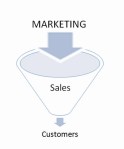
A sale is the act of selling a product or service in return for money or other compensation. Signalling completion of the prospective stage, it is the beginning of an engagement between customer and vendor or the extension of that engagement.

Marketing is defined by Wikipedia as –

Marketing is the process of communicating the value of a product or service to customers, for the purpose of selling the product or service. It is a critical business function for attracting customers.

To me sales, therefore, is an outcome of marketing. i.e sales is something that happens where marketing is the continuous process that facilitates it. Yes, marketing can and does play a major part in influencing a companies’ sales, but simply “doing some marketing” is not an instant route to increased sales! Marketing is very much an ongoing element to your business that has a start, a middle but no end.

However, what I would suggest is that, if your company simply wants more sales, you look at the offer you are making to the market first to make sure that the way in which you market the company will make a real and positive impact to your sales. Questions to ask yourself could well be……

Does the market you are talking to really exist?
Do some street and online research if need be to see what your target actually wants. After all, there is no point in making an amazing product that no one will really want (think Dragons Den!)

What is your brand saying about?
Are you coming across incorrectly? Don’t have a quirky logo with a wacky graphic if you are a more corporate type of company.

Is the look and identity really and truly reflective?
Don’t make false claims or say anything you cannot substantiate – “we provide the best service in Somerset….”

Is your USP clear?
Make sure you outline the reasons for people to work with you/buy from you

What platforms are you using to promote your company?
Where are you talking to your audience? There is no point in running a bus inner campaign when your target market are unlikely to use public transport.

What style and/or design you use?
Design is very subjective so don’t get too close to the design. After all, it is unlikely you are your own target audience.

What method and what frequency?
Are you advertising your company/product in the wrong magazine or maybe only advertising twice a year and therefore, are not building up brand awareness.

What are your competitors doing?
You are likely to be releasing your message into a noisy market; make sure you are heard and keep a close eye on your enemies!

Are there likely to be seasonal fluctuations that influence decisions?
An example of which could be a decrease in market size due to a national holiday period

Does each platform require a different approach?
It isn’t often that “one size fits all” and you need to make sure that the platform you use to market yourself is saying the right thing to the right audience. Consumers want to feel special so cut your cloth accordingly!

Is your pricing structure clear and justifiable?
Too cheap and people will be suspicious or not value what you are offering. Too expensive and people will form the wrong opinion of you.

The above are not the full suite of questions I’d want to know the answers to, but try them on yourself, talk to a marketing company who could then put a strategic marketing plan together………………….which will help sales!
 

Internet Marketing – 3 eras.

Do you have a website?
Of course you do; you couldn’t resist it eh?!!!
After all everybody has a website these days so you had to have one too. How did you go about finding someone to help you? Yellow Pages? Google? Find a friend? Either way, one of the main problems with a lot of websites is that they fall into the “About Us” category……they all look the same and say the same thing.

To make your website stand out, you must do something different. Remember the rule – “be helpful” – and that means offering interest and/or value. For example, a website that offers advice, tips, free data, training, instruction or even has a game of some sort is more likely to illicit some sort of response which ideally takes the form of someone identifying themselves and/or giving up their details.

We feel that Internet Marketing could be grouped into 3 “eras:”

Yesterday – the first era of Internet Marketing
This was the online brochure era. If you “were on the web” you were cool! Just being able to show your company there lead to an immediate increase in status! Then came the hip design side of the web usually created in “Flash” with lots of whizzy bits, colours and design bits. This then lead to all sites looking the same – the About Us syndrome.

Today – the second era of Internet Marketing
People have started to include something of value to their site visitors. About YOU vs About Us! These sites build traffic and relationships by giving the visitor access to information. The hoped-for payoff is that they then navigate around the site clocking up page views and possibly enquiring.

Tomorrow – the third era of Internet Marketing
The purpose of the website has shifted full scale in this era. The purpose is now to crystalise the company’s personality – to provide a rich and interactive experience; to make the company seem like an old friend before you’ve met the people behind it. The stylistic effects used are not for self indulgence, but for the identity of the company.

Need any help? Email Bath Marketing Consultancy

How valuable are your clients?

Every business needs clients and the income they bring in order to not only sustain business, but to grow. But………….each client has a different value and how do you determine this “value?”

Firstly, you need to do a realistic assessment of the monetary value of the client to your organisation. Secondly, conduct a review of the cross selling opportunities. In the first case you should be assigning a value to you of the client: everyone instinctively knows that not all clients are profitable and that some are more profitable than others. Get the figures and study them, including maybe a “lifetime” projection. You should be reviewing administration time, the allocation of resources, travel, expenses incurred and maybe even the emotional time dedicated!

In the second case, I am talking about you and your colleagues co-operating in order to exploit the opportunities within a client organisation to the full. Getting more from an existing client is 10 times easier that winning a new client from scratch so do not make the assumption that the client knows exactly what other goods and services your business offers. Have you considered doing a client review? In this previous article I talk about some of the options you could implement.

In addition to the audit process to determine the value, one option for cross selling could be to run some sort of seminar with existing clients. The content of the seminar would need to be given serious thought, but selecting a relevant topic or possibly offering some training could work well. Both of these routes are ideal for maintaining visibility, for enhancing reputation and for giving the client something tangible to take away.

In my opinion, the glory days of a corporate jolly are long gone as clients usually want something tangible to justify giving up their time to a supplier!

Conferences and exhibitions might also be considered, but these are another story all together…..!!

Public Relations for Purpose

Over the last few months a number of clients have asked me about PR and whether it is an area to explore as part of the marketing mix. Yes, I replied, but are we both clear on exactly what PR is?!

Although not a core service offered by Bath Marketing Consultancy, PR can prove very fruitful. Let’s start by clarifying what it actually stands for. In my opinion, PR stands for press relations as well as public relations and, when implemented correctly and strategically it can effectively contribute to winning new business both directly and indirectly.

PR is not just about column inches in the local press. PR should address attitudes and consumer perception. It should be used

to tantalize your public into following up on your stories and so revealing themselves as prospects and press relations are a good way of achieving the above.

PR can be used for a number of purposes (managing a reputation, dealing with a disaster, promoting a new product etc etc), but one clear objective could very well be the opening of new doors. This is done by actively targeting your public to contact you rather than simply raising awareness of your organisation and/or products. PR can generate leads and can provide great support to a new business drive, but the message you use must be in harmony with the other marketing activity you do.

While you cannot force the media to feature you or your press releases, always supplying a contact name and phone number as an integral part of your actions is a must. Keep your organisation’s name consistent across your releases and ensure your colleagues do so e.g decide whether to use the full name, initials etc.

You will find that PR will generate its own “atmosphere” within which new business activities can flourish as PR often softens the actual selling process.

But what stories do we submit to the media??

Always aim for stories of interest.
Research – maybe research based either on behalf of an external client or bespoke research.
Reports – maybe on an industry or a market on which the company has a view
Trends – maybe predictions or influences trends have had to your organisation
Compelling stories – maybe a marketing success and/or a human interest story
Client generated stories – maybe a new business win, a case study on how the results were achieved
News – maybe a new appointment, some industry gossip or extracts from a diary

Whatever you decide to submit, try not to give the whole story away in one article. Ideally, you should look to tease and tempt so that the media come back to you for updates + the prospects will enquire direct to you to find out more!