Author: Paul Tagent
Technology means you CAN take time off.
 |
| Worldwide access |
I cannot tell you all how much better I have felt this week while away from my business than last time I took a week off back in October 2010. After that week, I wrote a post about the merits of working while officially off which provoked a number of comments as I found myself working every night and very stressed, but this time, things have been very different for me.
Why?
Well, for a start, the investments I have made in technology have made a huge difference. I now have a “proper” office so am able to separate work time and home time much better. Even better is that, in my office I have a VOIP phone system that takes messages and emails me the voice mail message via Quick Time so I never miss a call.
In addition to this, Bath Marketing Consultancy has grown significantly over the last 6+ months and I am now in a position to work with a creative director who can act as my back up while I am away and/or out of the office. Although not an “employee”, he is a retained freelancer with a Bath Marketing Consultancy email address and we have been working together for over a year on a project by project basis anyway so he knows my business, my brand and most of my clients.
The final ways that have helped me relax (well, I say relax, but I have 3 children under the age of 5 so I use the expression loosely!), is that the house I have rented has wi fi which allows me to access the PC in my office remotely via a system called “Team Viewer” if I need to and of course, no business would be complete these days without the obligatory iphone which syncs with my email system via an external email exchange.
I cannot tell you how much easier it is to have a few days off knowing that all phone calls are covered and that there is someone else to help if need be and the investments my business has made in technology make breaks far easier to take. I wont lie and say that this week has been client free. In fact, I have had 2 new enquiries, worked on a new logo for a client, produced 2 new A4 folders plus started putting together a new website, but I now do it with a smile on my face rather than a look of frustration and panic!
What do you think? Are you able to take time away from the “coal face” or are you a slave to your business? Let me know by leaving a comment below.
What is the best form of marketing for my business?
This question has raised its head a number of times recently as we are entering a time where seasonal fluctuations for some businesses can mean a downturn in business, but, in all honesty, it is very tricky to answer this one.
As we all know, each business is different and therefore is likely to require different results from its marketing activity. i.e yes, sales are key, but what sort of sales and would increasing repeat business be a quicker way to increase revenue rather than driving new client acquisition?
So……….how do I answer this question of the “best marketing” without possibly coming across as evasive?? Well, I tell clients and prospects that the only true way of discovering what works for their businesses is to test initiatives. For example, don’t fall victim to the Chinese whispers that direct mail doesn’t work or advertising doesn’t work, try them and see what happens. Include reference numbers and/or unique phone numbers to gauge response levels.
Also, I have found that, as marketing budgets shrink, ROI expectations seem to be increasing and some clients seem to pin all their hopes on a quick fix to a problem.
 |
| Talk to someone! |
Stop this now! Marketing is all about identifying and fulfilling a need and this takes time. Don’t think of marketing as spending unnecessary money. Think of it as investing in the future of your business and building your brand.
The true success of a brand is measured in years and decades not months so don’t give up at the first hurdle and, if need be, talk to someone outside of your business to see what he/she thinks.
Search Engine Optimization – what not to do.
 |
| Play with a straight bat. |
Following on from my previous article about what to do for SEO, please find Bath Marketing Consultancy’s list of don’ts –
1. Avoid cloaking – Cloaking is when you give your visitors one page and then give search engines another page. Google and its friends want to see and index what your visitors see. Getting caught cloaking can have dire consequences on your site ranking.
2. Avoid keyword stuffing/spamming – This is stuffing your webpage with keywords that are only intended at tricking the search engines. Google is wise to this so, to get the best outcome, just write your text, with keywords in mind, towards your audience.
3. Avoid using flash or javascript for your navigation methods – Search engines usually can’t read these, or read them well enough to be dependable. Always use standard html links to be sure your site is easily walk able by search engine spiders.
4. Don’t submit your webpage url too often, if at all – You can submit your url directly to search engines, though search engines prefer to find your website via a backlink or incoming link. Resubmitting weekly or monthly can heavily damage your ranking with the search engines.
5. Avoid the “quickly get submitted to thousands of search engines” deals – While many of these do what they say, keep in mind that 98-99% of all search engines are powered by Google, Yahoo, or MSN. Just keep these 3 in mind and you’re covered.
6. Don’t forget backlinks – Link popularity plays very large into how your site is ranking by search engines, and is always a key element of SEO. Miss the backlinks part, and your SEO will suffer quite a bit.
7. Avoid excessive graphics and flash presentations – This is not to alter how the search engine looks at your site (directly), but at how your visitors view your site. There are many ways to make an effective website without overloading your visitors, and if a website takes more than 5 seconds to load, you will likely lose your visitor before they even get to visit your website.
To me SEO is about ticking the right boxes and making things relevant and easy for Google. Yes, there are tricks of the trade, but playing with a straight bat and making your site relevant, trustworthy and, above all, trustworthy will really help in effective SEO.
Search Engine Optimization; what you do
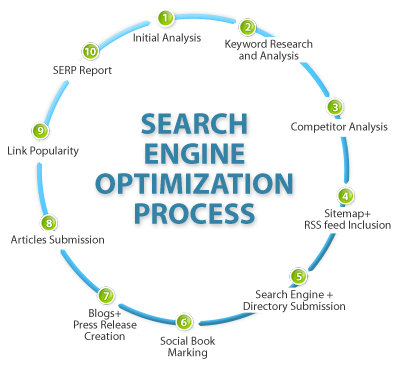
I wanted to put together a list of do’s and don’ts for you to read and, while I was writing my list, I came across a similar article from a chap called Kuldeep Singh that I have encoporated into Bath Marketing Consultancy’s list.
1. Original content – Search engines love websites with original (and relevant) content, which will also naturally draw incoming links and visitors as well. “Original” content can be anything from product reviews to your own articles and/or news and Blogs.
2. Add more content regularly – How often a website is updated can have a big impact on your search engine ranking. Most search engines prefer fresh content.
3. Research your keywords – You need to research which keywords you want to target before you even start making your website. These are the keywords that you will be targeting in backlinks when possible and your main page will revolve around these keywords. You can conduct your research using Google and the other search engines and then write your website content accordingly.
4. Create a sitemap – Sitemaps are a definitely plus (and can be created for free) as they help search engines walk your website as you have mapped everything out. It can also greatly help visitors find what they are looking for on your website. Be sure to link to your sitemap from your main page.
5. Use HTML – While this may sound obvious, there are sites out there created entirely in flash or javascript which is a definite no no for SEO. While some search engines can read part of javascript, by not using regular html link between pages, your site may not even get seen by search engines.
6. W3C compliant – Making your web pages complies with the World Wide Web Consortium’s standards is always a good idea. It is impossible to know exactly how the search engine spiders read a web page, so it is impossible to know how it will handle non-standard code. You can bet, though, that it has been tested to handle html code that follows the standard.
7. Webpage title tag – Be sure to put your target keywords in your title tag – the writing at the very top of your page.
8. Build backlinks at a normal pace – NEVER use one of those link farm programs where every member automatically shows links to all the other members. Search engines will see you one day literally showing thousands of backlinks instantly and this could get you penalized or banned which has actually happened to a client of mine before he came to Bath Marketing Consultancy.
If you are a regular reader of The Marketing Expert you will know that I have written many articles on SEO and how to get the best from your website, but, I think it is worth pointing out that I practice what i preach.
Effective marketing comes after market research
 How many of us in business actually research our market before jumping straight in and starting a new business or embarking on a marketing drive? I would guess that most businesses have the idea first and then go straight to market without even asking anyone (especially their target market) whether their idea is a good one or not!
In a nutshell, if you define marketing as “identifying and then supplying customer needs,” my feeling is that market research provides the objective means of achieving this and, without conducting research, how do you know if there will be a demand for your business or not?
Being armed with a clear understanding of these “needs” prior to you building your sales & marketing plan could make all the difference. In addition, the results of the market research you employ should allow your organisation to differentiate itself from its competitors and hence build your brand and win business.
I believe there are roughly 5 main approaches you could employ when looking at research and these are – researching benefits and limitations, whether (and how) to brief a research agency, DIY research, qualitative studies and quantitative studies.
I could go over all 5, but for the SME, it is the DIY research that is probably most attractive as the costs are generally low and the business owner can drive things. So…….what areas do I suggest you look at?
Define your sample – the size, the location, the demographics etc
Choose your research method – telephone, email, face to face etc
Design a quality questionnaire – make it thorough and reflective
Collect your data
Clean your data
Make sure that all info is stored on your database
Interpret and report
None of the above is set in stone, but, in my experience, I would always want to invest time with the organisation I am working with to find out what they are all about before I started putting down a concrete plan……….and maybe, by researching their “offer” the process of marketing could be made slicker and more effective for the potential client too!
Just a thought…..
AIDA – explain it please.
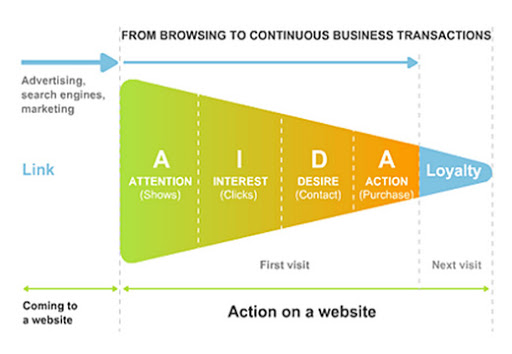 I am pretty sure you have all heard of AIDA – the 4 key areas of advertising – but do you know exactly what they stand for and how to encompass them into your advertising strategy?
A – Capture the customer’s attention and make him AWARE of the product/service you are offering
I – Make an IMPACT and stimulate his interest.
D – Persuade him that he is deprived because he does not possess the product/service you are offering and therefore stimulate a DESIRE or demand for it.
A – The actual purchase made or ACTION taken.
There are however, difficulties associated with assessing the effectiveness of your promotional expenditure, mainly because of the possible delays taken to yield a result or action. In the case of advertising, a distinction must be made between what is known as direct response advertising and brand awareness advertising. The former is widely used when selling a product i.e. the retail industry where a sofa is on sale for a limited time. Whereas the latter type of advertising might be used to build awareness in the first instance.
In Bath Marketing Consultancy’s opinion, the objectives of an advertising campaign may need the following –
1. To support a brand by stressing its advantages
2. To attack a competitor (directly or indirectly!) and hence increase market share
3. To increase total sales by aiming to increase market share within the existing market
4. To co-operate with producers of jointly used products = mutual approval
5. To appeal to a new segment or market
6. To convey and image of the firm rather than an actual product/service
7. To support a particular marketing strategy
8. To support a decision to buy after the purchase has actually been made
Most advertising does much more than maintain an existing position, but I feel it should be an essential part of an organizations overall marketing strategy for areas like brand loyalty are very fickle and hence, organizations need to continue to remain “on radar” with their customers and prospects. I am not saying that regular advertising will bring you one step closer to retirement; more that it certainly has a place within your marketing activity so dismiss it at your peril.
To blog or not to blog…
…..that is the question! For the first time in years, I have genuinely found myself at a slight loss as to what to write about this week. Since 2009, “The Marketing Expert” has written some 180 articles for this Blog; most of which have been dedicated to helping the small to medium business with their marketing by providing tips and/or sharing experiences and the feedback I have had has been incredibly positive so many thanks to my readers and keep the emails coming!
Anyway, I digress. In a nutshell, I have found the marketing industry has changed hugely in recent times and a great deal of initiatives that can now be employed are “free.” This might be considered a good thing by the business owner who can very quickly set up a website, a Twitter account, a Blog, a Linkedin account etc and start their online marketing.
 |
| Leave a good footprint |
BUT, with these sorts of platforms being so readily available, I feel it is even more important to make sure that using them becomes a part of an organisation’s overall marketing strategy. Remember, everything one does on the world wide web leaves a footprint which can be seen by anyone or any organisation. This means that the emphasis for leaving a quality footprint is incredibly strong.
So, what does putting a marketing strategy together actually mean and why do I need to do one? Well, the short answer to this is that a marketing strategy is about thinking and planning what your business wants to achieve.
In my opinion, an adhoc, knee jerk marketing campaign very quickly becomes inconsistent, hard to monitor and can yield very little actual value for your business. To me, it is absolutely paramount that any business gives serious thought to exactly what it is offering, to who and why before putting together a logo or any brand identity. In addition, just putting together a quick (cheap!) logo and bunging it up on a WordPress website and then Tweeting is not what I would call a creditable way forward. Cheap can sometimes work out to be very expensive.
My suggestion is to talk to a marketing professional about your plans; bounce ideas off someone so that you have a second opinion. I have lost count of the amount of times I have met a client who has been 6-12 months into their business having jumped straight in with both feet and pulled in every favour possible from friends and relatives who might “know computers” and have now found themselves wanting to back track and do it properly.
Clarity and authenticity are key elements for a business and investing (and I stress the word “investing”) in your business initially by working with a professional could make all the difference.
Video interview for the Bath Life Awards 2011
How tired do I look??!
Keep Sight of the Bigger Picture in SEO
Having a website that ranks in the top 5 or 10 search positions for competitive search terms can be very lucrative especially as a single marketing initiative. As such, there are numerous highly successful organisations who market this one thing: rank pages in the top 10 for various competitive search terms. Yet for most companies, the huge effort that it can take to achieve a top position is not worthwhile unless there are secondary marketing goals.
Secondary goals may be to actually sell your goods/services, or get people to register on you site etc. A very important distinction that you should always keep in mind is that some search terms may be highly converting (get the users to do what the webmaster wants them to do) and some search terms that seem like they should convert, do not.
So…..sometimes a customer “sign up” following a specific term might be the best way of converting a browser to a customer as you will then have the email address to run dedicated emarketing.
 |
| Get your SEO ducks in a row! |
Either way, my suggestion is to make sure that your site will actually be capable of ranking in a top10 position for some searches; maybe look at regional terms initially (feel free to do a search for marketing company bath and see who dominates the first page of Google – me!), but………..be warned, there are many things you can do to influence where your website appears so be sure to tick as many of the SEO boxes as possible and do not expect to be there within weeks of going live.
 Marketing Articles